
Blog ·
Marine Water Filter Systems for Boats & Yachts: Specs, Sizing & OEM Sourcing
Complete B2B guide to marine water filtration — dockside inlet filters, galley point-of-use cartridges, watermaker pre-filters, Everpure marine cross-reference, ABYC H-23 and NSF/ANSI 61 requirements, plus FOB pricing and MOQ for chandlery distributors.
Marine Water Filter Systems for Boats & Yachts: The B2B Sourcing Guide
Quick answer: A properly specified boat water system uses two filtration points, not one. A 5–20 micron sediment filter on the dockside fill line protects the tank and keeps fill flow above 4 GPM. A 0.5–1 micron carbon block at the galley tap handles chlorine, taste and cysts. Housings must be UV-stabilised, gasketed with EPDM, and bracketed in 316 stainless. Get those three decisions right and a marine filtration SKU sells itself to every boatyard within reach.
We manufacture water filter cartridges in Ningbo for distributors in 40+ countries, and marine is one of the few remaining categories where a mid-sized chandlery distributor can still build a defensible replacement-parts business. The installed base is fragmented, the OEM parts are expensive, and almost nobody publishes honest specification guidance. This guide fixes that.
Why Boat Water Is a Different Filtration Problem
Land-based point-of-use filtration solves one problem: municipal water is safe but tastes of chlorine. Boat water fails in four different ways at once, and each one needs a different answer.
The dockside hose is the contaminant source, not the tank. Marina standpipes sit outdoors, are used intermittently, and often run through galvanised pipe that has been in the ground since the 1970s. What comes out of a marina hose typically carries rust flake, sand, biofilm slough and — in older US and Southern European marinas — a strong hypochlorite dose from shock-chlorination of the dock main. Filtering at the tap does nothing about the sediment that is already sitting in the bottom of the tank.
Tanks sit dormant. A cruising boat may fill in June and not empty the tank until September. Polyethylene and stainless tanks both support biofilm at 20–30 °C. Chlorine residual in a closed tank falls below the 0.2 mg/L free-chlorine threshold that the US Public Health Service Vessel Sanitation Program treats as the minimum for potable water within days.
Flow and pressure are tight. A typical onboard pressure pump (Shurflo, Jabsco) delivers 3–5 GPM at 30–45 psi. A land system has 60 psi to give away. On a boat, a 6 psi pressure drop across a badly chosen cartridge is a noticeable loss of shower pressure. Pressure-drop budgeting matters far more at sea than ashore.
The environment attacks the hardware. Salt aerosol, UV through deck hatches, vibration from a diesel at 2,200 rpm, and freeze cycles during winter lay-up. A housing designed for an under-sink cabinet in Ohio will chalk, craze and eventually split.
The Two-Stage Architecture Every Boat Needs
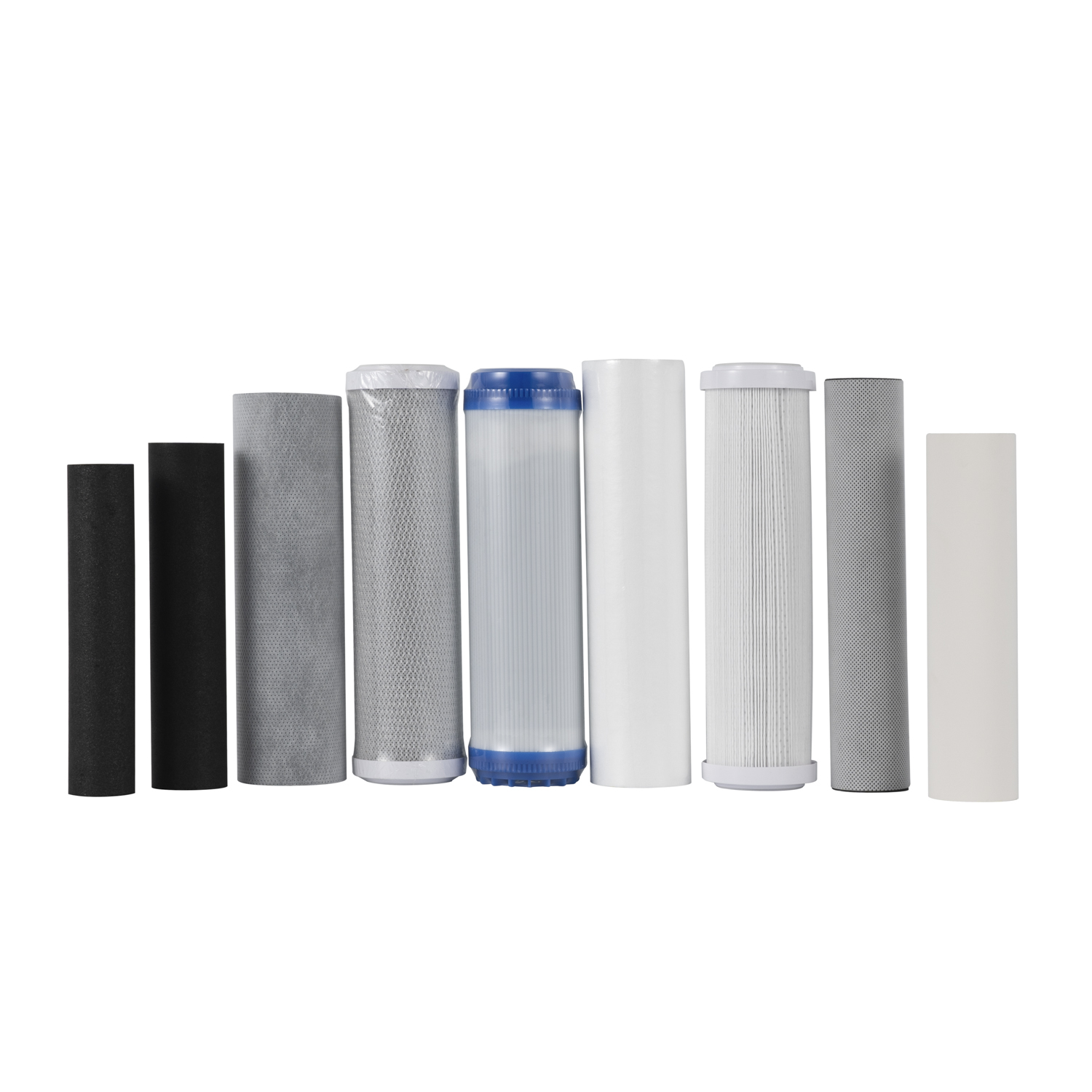
Almost every well-designed potable water system on a vessel under 30 m follows the same pattern. Specify to this and you will rarely be wrong.
| Position | Purpose | Cartridge type | Micron | Flow needed | Typical service life |
|---|---|---|---|---|---|
| Stage 1 — Dockside / tank fill | Keep rust, sand and biofilm out of the tank | Pleated polyester or spun PP | 5–20 µm | 4–8 GPM | 3–6 months / 500–1,000 gal |
| Stage 2 — Galley point-of-use | Chlorine, taste, odour, cysts, particulate | Carbon block (CTO) | 0.5–1 µm | 0.75–1.5 GPM | 6 months / 1,000 gal |
| Optional — Watermaker pre-filter | Protect the high-pressure membrane | Spun PP, two stages | 20 µm then 5 µm | Per watermaker spec | 50–100 running hours |
| Optional — Ice maker / fridge | Scale and taste on the appliance feed | Inline quick-connect carbon | 5 µm | 0.5 GPM | 6–12 months |
The single most common installation error is fitting one 0.5 micron carbon block on the fill line and calling it done. A 10” × 2.5” carbon block is rated for roughly 1 GPM. Filling a 400 L tank through it takes about 105 minutes instead of 15, so the owner removes it after the second fill and stops filtering entirely. If you sell one cartridge into a boat, sell the sediment cartridge — it is the one that survives contact with reality.
For the sediment stage, spun polypropylene is the volume choice and pleated polyester is the premium one. Pleated cartridges can be rinsed and reused several times, which cruisers crossing oceans value highly because they cannot resupply. We cover the manufacturing differences in detail in our PP sediment cartridge guide, and the carbon block side in the CTO carbon block cartridge guide.
Sizing: Housing Format vs Actual Flow
Distributors routinely under-size marine housings because they quote on price rather than on flow. Here is the honest capacity table.
| Housing format | Cartridge size | Sediment flow @ <3 psi Δp | Carbon block flow | Best marine use |
|---|---|---|---|---|
| Inline quick-connect | 2” × 10” QC | 0.5–1.5 GPM | 0.5 GPM | Ice maker, fridge, single tap |
| Standard 10” | 10” × 2.5” | 4–6 GPM | 0.75–1 GPM | Galley POU; small-boat fill |
| Standard 20” | 20” × 2.5” | 8–10 GPM | 1.5–2 GPM | Fill line on 40–60 ft boats |
| Big Blue 10” | 10” × 4.5” | 8–12 GPM | 3–4 GPM | Whole-vessel, 50 ft+ |
| Big Blue 20” | 20” × 4.5” | 15–20 GPM | 6–8 GPM | Charter, commercial, small ferry |
Two practical rules from the field:
- Budget the total pressure drop at under 5 psi across every filter in series, measured with a fouled cartridge, not a new one. On a 40 psi system that leaves the shower usable.
- Size the fill filter for the dock hose, not the boat. A 3/4” marina hose at 50 psi delivers 5–8 GPM. If your filter chokes that to 2 GPM, the owner uninstalls it.
The standard 10-inch format is worth defending as your core marine SKU for one non-obvious reason: it is available in every port on earth. A cruiser in Panama can find a 10” × 2.5” cartridge; they cannot find a proprietary bayonet cartridge. That is why long-distance sailors overwhelmingly convert their boats to the universal format, and why it should be the platform you stock. See our cartridge size and compatibility chart for the full dimensional reference.
Everpure Marine and the Compatible-Cartridge Opportunity
Everpure holds the largest share of the factory-fitted yacht market. Production builders — and most refit yards — install an Everpure quick-change head, usually the QC7I single or twin manifold, with one of a handful of cartridges. Understanding this installed base is the whole commercial argument for a marine cartridge line.
| Everpure cartridge commonly found on boats | Nominal micron | Rated capacity | Typical application on board |
|---|---|---|---|
| 4C | 0.5 µm | 750 gal | Galley tap, small vessels |
| MC² | 0.5 µm | 9,000 gal | Galley + ice maker, mid-size yachts |
| H-104 | 0.5 µm | 1,000 gal | Single-tap POU, tenders and sportfish |
| H-300 | 0.5 µm | 300 gal (high flow) | High-flow galley on larger yachts |
| H-54 | 0.5 µm | 750 gal | Compact installations |
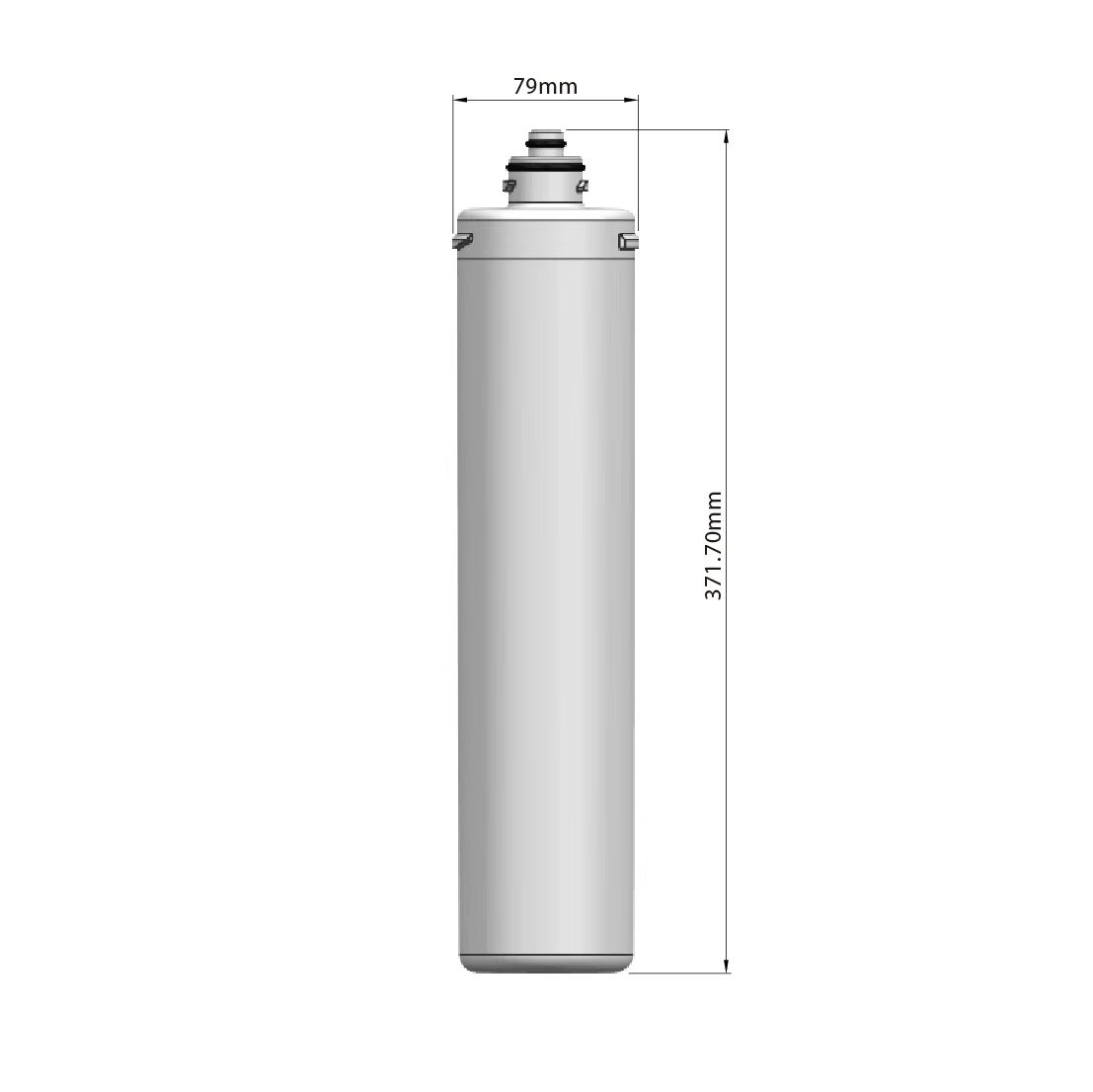
All of these use a bayonet quick-change interface with a standardised cartridge collar. A cartridge built to the same interface geometry and the same 0.5 micron carbon block media drops into the existing head with no plumbing change — which is exactly why compatible cartridges have taken so much of the aftermarket. We build to these interfaces on our Everpure-compatible cartridge line, and the full model-by-model mapping is in the Everpure cross-reference chart.
The distributor economics. An OEM MC² retails in the $85–130 band in marine chandlery. A compatible equivalent lands at $9–16 depending on volume and freight lane, and retails comfortably at $38–55. Marine buyers are less price-sensitive than grocery-channel buyers but far more sensitive to availability — the boat is leaving Saturday. Stock depth, not price, wins this category.
Materials and Standards: What Marine Actually Requires
This is where a marine SKU differs from a repackaged household SKU, and where most importers get caught out on a warranty claim.
Housing and sump. Specify UV-stabilised polypropylene or glass-reinforced nylon. Standard clear SAN sumps craze under UV and go brittle within two seasons in the tropics — acceptable in a kitchen cabinet, not in a deck locker. Confirm a working pressure of at least 125 psi and a temperature range covering 0–45 °C.
Seals. EPDM or food-grade silicone O-rings, not nitrile. Nitrile takes a compression set faster under thermal cycling and is the usual cause of the slow weep that shows up as a wet bilge.
Brackets and fasteners. 316 stainless, not 304. In a salt-spray environment 304 develops surface rust within a season, and while that is cosmetic rather than structural, it generates returns.
Standards to hold your supplier to:
- NSF/ANSI 61 — drinking water system components, material safety. This is the baseline for anything in a potable line.
- NSF/ANSI 42 — aesthetic effects (chlorine, taste, odour, particulate). This is the performance claim for a carbon block.
- ABYC H-23 — the American Boat & Yacht Council standard for potable water systems on boats. Requires non-toxic materials throughout the system and governs installation practice. Yards in the US work to it.
- EU 10/2011 / WRAS — food-contact plastics in the EU and the UK water-fittings approval respectively, for European distribution.
- USPH VSP — if you are selling into commercial passenger vessels, the Vessel Sanitation Program requires a free-chlorine residual of at least 0.2 mg/L in the potable distribution system, which constrains where you may place a dechlorinating carbon stage.
Watch for the certification sleight of hand that runs through this whole industry: a great many products advertise “NSF certified” when the certification covers materials under Standard 61 only, with no performance testing under 42 or 53. Ask which standard, which certificate number, and whether the listing is searchable in the certifier’s database. Our NSF certification guide explains how to read a listing properly.
Watermakers: A Separate Specification Entirely
Yachts over about 45 ft increasingly carry a seawater reverse-osmosis watermaker, and the pre-filter consumables are a high-frequency repeat sale — far higher turnover than potable cartridges because the duty cycle is brutal.
Standard seawater watermaker pre-treatment is two sediment stages, 20 micron followed by 5 micron, both spun or pleated polypropylene, sized for the feed pump rate. Cartridge life is measured in running hours rather than gallons, typically 50–100 hours, and collapses to a fraction of that in nutrient-rich coastal water or anywhere with algal bloom.
Do not put carbon ahead of a seawater membrane. There is no chlorine in seawater to remove, and a carbon bed sitting wet and stagnant between passages becomes a bacterial culture vessel that discharges directly onto a $1,200 membrane. Carbon belongs upstream of a membrane only when the feed is chlorinated dockside water — a dockside-fed booster RO, not a watermaker. The general trade-offs between membrane technologies are covered in our RO vs UF vs NF comparison, and complete system configurations on our reverse osmosis systems page.
Lay-Up, Dormancy and the Biofilm Problem
This is the failure mode nobody warns boat owners about, and it is worth building into your product documentation because it prevents the most damaging category of complaint: “your filter made the water taste worse.”
A carbon block that has been wet, then sat in a warm locker for four months of winter lay-up, is a nutrient-rich substrate at ambient temperature with no chlorine residual. It will support heterotrophic bacterial growth. When the owner recommissions in spring and runs the tap, the first litres carry an unmistakable musty taste — and the filter gets blamed for water it in fact contaminated.
The correct lay-up procedure, which should be printed on your carton:
- Drain the tank and the system at the end of the season.
- Remove the cartridge and discard it. Do not attempt to dry and reuse a carbon block.
- Wash the sump in warm soapy water, rinse, and store it dry and unassembled so the O-ring is not compressed.
- At spring commissioning, sanitise the tank per ABYC H-23 guidance, flush thoroughly, then fit a fresh cartridge.
Sequencing matters in step 4: fitting the new cartridge before the sanitising flush dumps a shock-chlorine dose straight into fresh carbon and consumes a meaningful fraction of its capacity in a single pass.
Unsold inventory has a related constraint. Dry carbon block and PP cartridges in sealed poly bags hold their properties for 24–36 months; once a bag is opened in a humid marina store the clock runs much faster. Our cartridge shelf life and storage guide has the storage conditions to specify to your warehouse.
FOB Pricing, MOQ and Building a Marine Line
Indicative factory pricing, FOB Ningbo, at 1,000-piece volumes per SKU:
| Item | Spec | FOB Ningbo (1,000 pcs) | FOB Ningbo (10,000 pcs) |
|---|---|---|---|
| Spun PP sediment | 10” × 2.5”, 5 µm | $0.25–0.40 | $0.18–0.28 |
| Spun PP sediment | 10” × 2.5”, 20 µm | $0.25–0.38 | $0.18–0.26 |
| Pleated polyester, washable | 10” × 2.5”, 5 µm | $0.90–1.60 | $0.70–1.20 |
| Carbon block (CTO) | 10” × 2.5”, 0.5 µm | $0.70–1.10 | $0.55–0.85 |
| Inline quick-connect carbon | 2” × 10” QC | $1.80–3.20 | $1.40–2.40 |
| Everpure-compatible QC cartridge | MC² / 4C / H-104 interface | $4.50–9.00 | $3.60–7.00 |
| Housing kit | 10” clear + bracket + wrench | $3.50–6.50 | $2.80–5.00 |
| Big Blue housing | 10” × 4.5”, 1” ports | $9.00–15.00 | $7.50–12.00 |
MOQ is 1,000 pieces per SKU on stock items and 3,000 pieces where private-label printing or custom carton artwork is involved. Full category pricing sits in our 2026 water filter price guide, and the freight and duty layer on top is worked through in the landed cost guide.
How to structure a first marine order. A viable entry line is four SKUs, not twenty:
- 10” spun PP, 5 µm — the fill-line workhorse, highest unit velocity
- 10” carbon block, 0.5 µm — the galley cartridge
- Everpure-compatible quick-change cartridge in the single most common local interface — the margin driver
- 10” housing kit with 316 bracket — the system sale that pulls the other three behind it
Four SKUs at 1,000 pieces each fits comfortably inside a single 20’ container with room for other categories, and covers roughly 80% of the potable installations you will encounter in a typical marina. Add the 20 µm and 5 µm watermaker pre-filters on the second order once you know how many watermaker-equipped boats sit in your territory.
Related Guides
- PP Sediment Filter Cartridges: Specifications & OEM Sourcing
- CTO Carbon Block Filter Cartridges: Complete Guide
- Everpure Water Filter Cross-Reference Chart
- NSF Water Filter Certification: What Buyers Need to Verify
- Water Filter Cartridge Size & Compatibility Chart
- Water Filter Cartridge Price Guide 2026
Talk to the Factory
XZH manufactures PP sediment, carbon block, quick-connect and Everpure-compatible cartridges in Ningbo, with UV-stabilised housings and 316 stainless bracket kits available for marine distribution. We supply chandlery distributors, boatyard supply groups and marine equipment importers with private-label cartons and NSF/ANSI 61 material documentation.
Send us your target interface list and annual volume and we will come back with an FOB quotation, lead time and sample plan. Contact our sales team or review our OEM manufacturing capabilities.
Frequently Asked Questions
- What micron rating should a boat water filter be?
- Use two different ratings at two different points. At the tank fill / dockside inlet, use 5–20 micron pleated or spun polypropylene so you get 4–8 GPM of flow without slowing the hose fill. At the galley tap, use a 0.5–1 micron carbon block, which handles chlorine, taste, odour and cysts. Putting a 0.5 micron carbon block on the fill line is the single most common mistake — it drops flow to roughly 1 GPM and blinds off within one or two tank fills.
- Are Everpure marine cartridges the only option for yacht water filters?
- No. Everpure marine kits are usually a QC7I quick-change head fitted with a 4C, MC², H-104 or H-300 cartridge. Those are all standard quick-change bayonet interfaces, so dimensionally compatible cartridges from other manufacturers fit the same head. Distributors typically stock a compatible cartridge alongside the OEM part at 40–60% lower landed cost, which is what makes the replacement business profitable.
- Do marine water filters need NSF certification?
- Any component in a potable water system on a boat should be made from materials evaluated to NSF/ANSI 61 or an equivalent food-contact standard (EU 10/2011, WRAS in the UK). ABYC H-23, the industry standard for potable water systems on boats, requires non-toxic materials throughout. NSF/ANSI 42 (aesthetic effects) covers the performance claim for chlorine and taste reduction. Note that many products are certified for materials only, not performance — read which standard the certificate actually covers.
- How often should boat water filter cartridges be replaced?
- Sediment cartridges on the fill line typically last 3–6 months or 500–1,000 gallons, whichever comes first. Galley carbon blocks are rated 6 months or around 1,000 gallons. The bigger issue on boats is dormancy — a wet cartridge sitting in a warm locker for a winter lay-up will grow biofilm. Vessels laid up seasonally should remove and discard the cartridge and store the housing dry, then fit a fresh cartridge at spring commissioning.
- Can I put a carbon filter before a watermaker membrane?
- For a seawater watermaker, no. There is no chlorine in seawater to remove, and a carbon bed sitting on stagnant seawater becomes a bacterial reactor that fouls the high-pressure membrane. Standard seawater watermaker pre-filtration is a 20 micron stage followed by a 5 micron stage, both sediment only. Carbon is only used ahead of a membrane when the feed is chlorinated dockside water, as in a dockside-fed RO booster.
- What is the MOQ and FOB price for OEM marine filter cartridges from China?
- Standard MOQ is 1,000 pieces per SKU for stock items and 3,000 pieces for private-label printing. FOB Ningbo pricing runs roughly $0.25–0.40 for a 10-inch spun PP sediment cartridge, $0.70–1.10 for a 10-inch 0.5 micron carbon block, $1.80–3.20 for an inline quick-connect carbon cartridge, and $3.50–6.50 for a complete 10-inch housing with bracket and wrench, all at 1,000-piece volumes.
- What housing material holds up in salt air and UV?
- Specify UV-stabilised polypropylene or reinforced nylon for the sump and cap, EPDM or food-grade silicone O-rings rather than nitrile, and 316 stainless steel for brackets and fasteners. 304 stainless will surface-rust in a salt-spray environment within a season. If the housing is mounted in a deck locker or an engine room, also confirm the working temperature rating covers 0–45 °C and that the sump is pressure-rated to at least 125 psi.
Looking for OEM Water Filter Cartridges?
Get a factory-direct quote from Ningbo XZH — 15+ years OEM experience, 50+ export markets, MOQ from 500 pcs.
Get a Free Quote →Get Our Full Product Catalog
100+ SKUs with specs, MOQ, and factory-direct wholesale pricing — everything covered in this article and more.